© 2010-2026 by Fine Arts of the Southwest, Inc. All rights reserved.
Unauthorized reproduction or use is strictly prohibited by law.

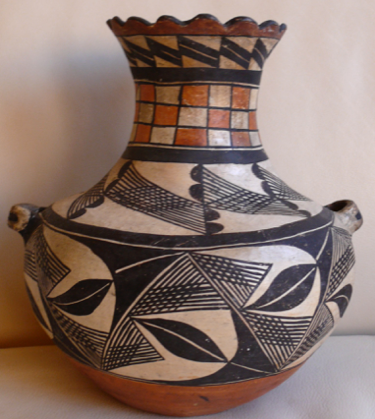
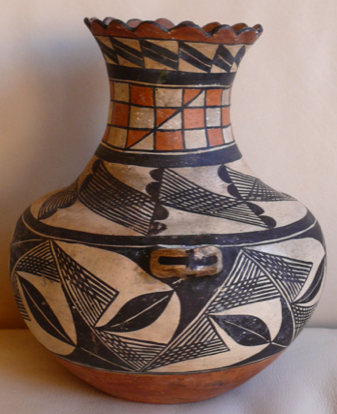
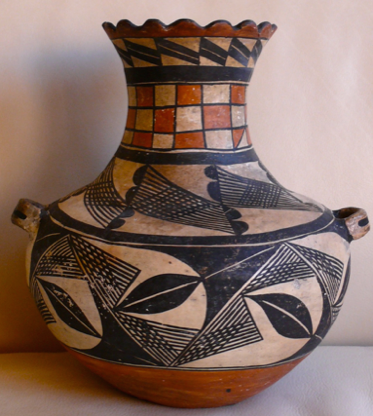
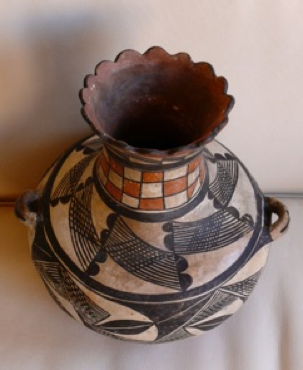
An Acoma Pueblo four-color
polychrome pottery jar attributed to Mary Histia, c.1920-1925
This beautiful jar is an early example of a so-called "railroad" jar, meaning Pueblo pottery jars which were sold to tourists in the early decades of the 20th Century who were traveling on the various trains of the Santa Fe Railway, The famous “Super Chief”, “Chief” and others which passed regularly east and west through the Acoma, Laguna and Isleta Indian Pueblos in New Mexico on their way to and from Los Angeles, Chicago and points farther east. The Pueblo potters would stand along the railroad sidings as shown in the historic Fred Harvey Company postcard below and sell their pots to passengers on the trains. This is a large and fairly early example of one of these jars, later ones were generally deliberately made somewhat smaller for increased portability.
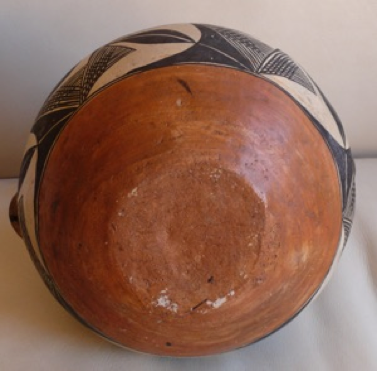
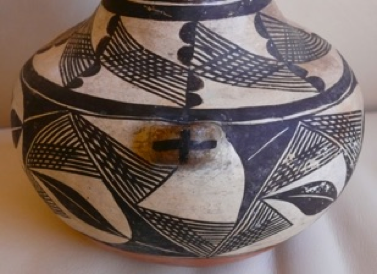
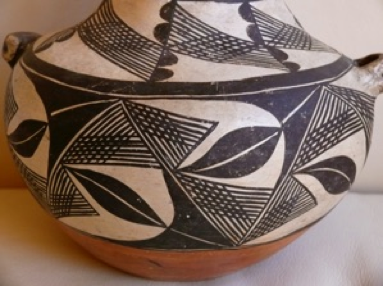
In addition to its larger size, this piece is unusual and remarkable for a number of other important reasons: First, it is a Pueblo adaptation of the upright form of a traditional utilitarian Pueblo “olla” or water jar into an elongated somewhat tall Victorian decorative vase shape with a longer, more narrow outflaring neck, a fancy non-utilitarian shape which the potters quickly learned was highly desirable to Anglo tourists for a display piece. The jar also has
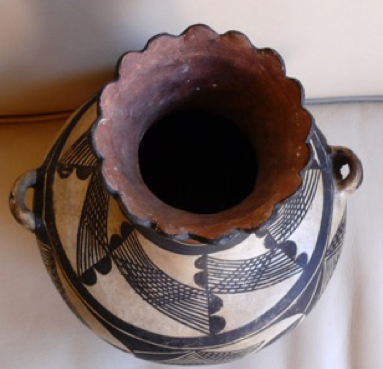
a deliberately made flat bottom intended to make it sit securely and evenly on a display table or shelf. Second, the jar is most beautifully, fancifully and precisely painted with four separate and completely different design bands as one descends downwards from the "piecrust" style fluted rim. Third, this is a four-color polychrome jar with black, white, orange and red as opposed to the usual three-color polychrome using black, white and orange or red.


Acoma Pueblo
________
Acoma Pueblo, about 65 miles west of present day Albuquerque, New Mexico lays a legitimate claim to being the oldest continuously inhabited place in the United States, established around 1150 A.D. Acoma Pueblo is an ancient village which plays a pivotal role in the history of the Southwest. Acoma was first seen through European eyes by Francisco Vazquez de Coronado in 1540. A half century later, in January, 1599, another Spanish Conquistador Juan Zaldivar de Onate engaged the Acoma Indians in a brutal three-day battle and subsequent massacre which culminated in numerous atrocities being perpetuated upon the Acoma people; a tragic event that has never been forgotten.
“Acoma Pueblo is built atop a sheer-walled, 367-foot sandstone bluff in a valley
studded with sacred, towering monoliths. Since 1150 A.D., Acoma Pueblo has earned
the reputation as the oldest continuously inhabited community in North America.
The mesa-top settlement is known worldwide for its unique art and rich culture. “
-Quotation source and © Sky City Cultural Center, Acoma Pueblo
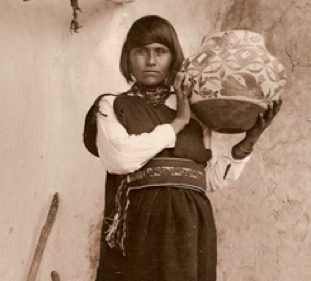
From the exceptional overall quality of the jar, the specific painted designs and the elaborate and extremely precise and highly-accomplished painting style, we can very strongly attribute this jar to one of the greatest Pueblo potters of the Nineteenth and Twentieth centuries, Mary “Acoma Mary” Histia (1881-1973), photos of whom are shown above. "Acoma Mary" was a pottery artist of astounding ability. Her Acoma Pueblo jars were often large and always beautifully and finely formed and distinctively decorated, the quality of her painting was beyond masterful.
A very large early Mary Histia Acoma pictorial parrot jar which was sold by our colleague, Richard M. Howard in Santa Fe for $450,000 still holds the world record for the highest price ever paid for a single piece of historic Pueblo pottery. Another mark of distinction for Mary Histia is that she traveled to Washington, DC, in the 1930’s and she became popular as sort of an unofficial potter to President Franklin D. Roosevelt. Subsequently, her pottery pieces decorated many Federal government offices in the nation’s capital.
Above left, an A.C. Vroman photograph of a young Mary Histia taken in 1902 entitled "Acoma Mary". Above center, a Fred
Harvey Company photo postcard, c. 1920 showing Pueblo women on a railroad platform siding selling pottery to passengers
on the Santa Fe Railroad at Laguna or Acoma Pueblo, New Mexico. At right, Mary Histia at Acoma Pueblo, c. 1935.
Left photo source and © Photographer of the Southwest, A.C. Vroman, Ward Ritchie Press. Center photo source and © Fred Harvey Company. Right photo source and © Burton Frashers Fotos, 1935.

This jar is unsigned as befits its fairly early c. 1920-1925 time period. With a few notable exceptions such as Maria Martinez, Pueblo pottery pieces were almost never signed by the artists who made them until the early-to-mid 1930’s. Mary Histia did not begin signing her pieces until at least the mid-to-late 1930’s.
The jar measures 10 1/2" in height and it is 9 3/4" in diameter at its widest point. It is in generally excellent condition overall with no cracks and no significant chips. There are some areas of paint restoration to several abraded areas around the upper neck and rim. The restoration was beautifully accomplished by master professional pottery restorer, Andres Goldschmidt of Corrales, New Mexico.
This jar is a superb piece of historic Pueblo pottery from the inspired mind and skilled hands of a master artist.
Mary Histia was one of the finest historic Pueblo pottery makers ever, in the very top echelon of Pueblo potters including Nampeyo of Hano, Maria Martinez of San Ildefonso and Margaret Tafoya of Santa Clara. This fine jar
would be a proud addition to any Pueblo pottery collection anywhere.
Price $3,600